Market Report ·
AI IPOs Are Minting a New Wealth Class. San Francisco's High End Is the Tell. The Hamptons Will Feel It.
By Barry McGovern · Hedgerow Exclusive Properties
The IPO Cycle That Breaks the Scale
Something is happening in public markets that most real estate conversations still treat as background noise.
SpaceX already priced the largest IPO in history in June 2026, raising about $75 billion. That alone is roughly three times Saudi Aramco's old record. OpenAI and Anthropic are next in the queue, with confidential filings in the books and valuation talk in the trillion-dollar range. Analyst estimates put the three-deal cluster near $200 billion in combined proceeds. That is more capital raised than all traditional U.S. IPOs from 2022 through early 2026 combined.
A point circulating from market podcasts this week lands the same idea in plainer English: these AI listings are not ordinary tech debuts. They are wealth events measured against the entire historical IPO stack. Whether you frame one of them as a record in its own right, or so large that everything else looks like a fraction of it, the direction is the same. They mint liquidity at a scale the trophy housing market has never had to absorb from a single industry cohort.
That liquidity does not stay in brokerage accounts forever. It finds irreplaceable real estate.
San Francisco's High End Is the Tell
Look west if you want the early tape for trophy real estate.
San Francisco's best neighborhoods are already repricing on AI cash, equity, and the anticipation of OpenAI and Anthropic liquidity. At the top of that market, the conversation is price per square foot on true high-end product: currently around $3,000 a foot in the circles that matter, with a credible path toward $5,000 as more AI wealth clears into housing.
That is the signal. Bids over ask. All-cash at the top. Competition for the few houses that clear the taste and location bar. Finite prime inventory meeting a buyer pool with absurd firepower.
Important nuance: a lot of this heat is already here from cash compensation and secondary share sales, before either company has rung the opening bell. The IPOs are not the start of the wealth wave. They are the amplification of a squeeze that is already visible at the ultra-luxury end.
When irreplaceable high-end stock cannot expand as fast as newly liquid AI wealth, price per foot does the adjusting.
Wealth Is Mobile. Coastline Is Not.
Here is the part that matters for the East End.
San Francisco is where a huge share of this wealth is being created. It is not where all of it will be spent. Newly liquid founders, investors, and senior AI talent already own or want second homes, third homes, and lifestyle hedges outside the Bay. The Hamptons have always been a preferred destination for that exact buyer: finance, tech, media, and anyone who wants ocean, privacy, and proximity to where capital actually lives.
The difference between San Francisco and the Hamptons is structural.
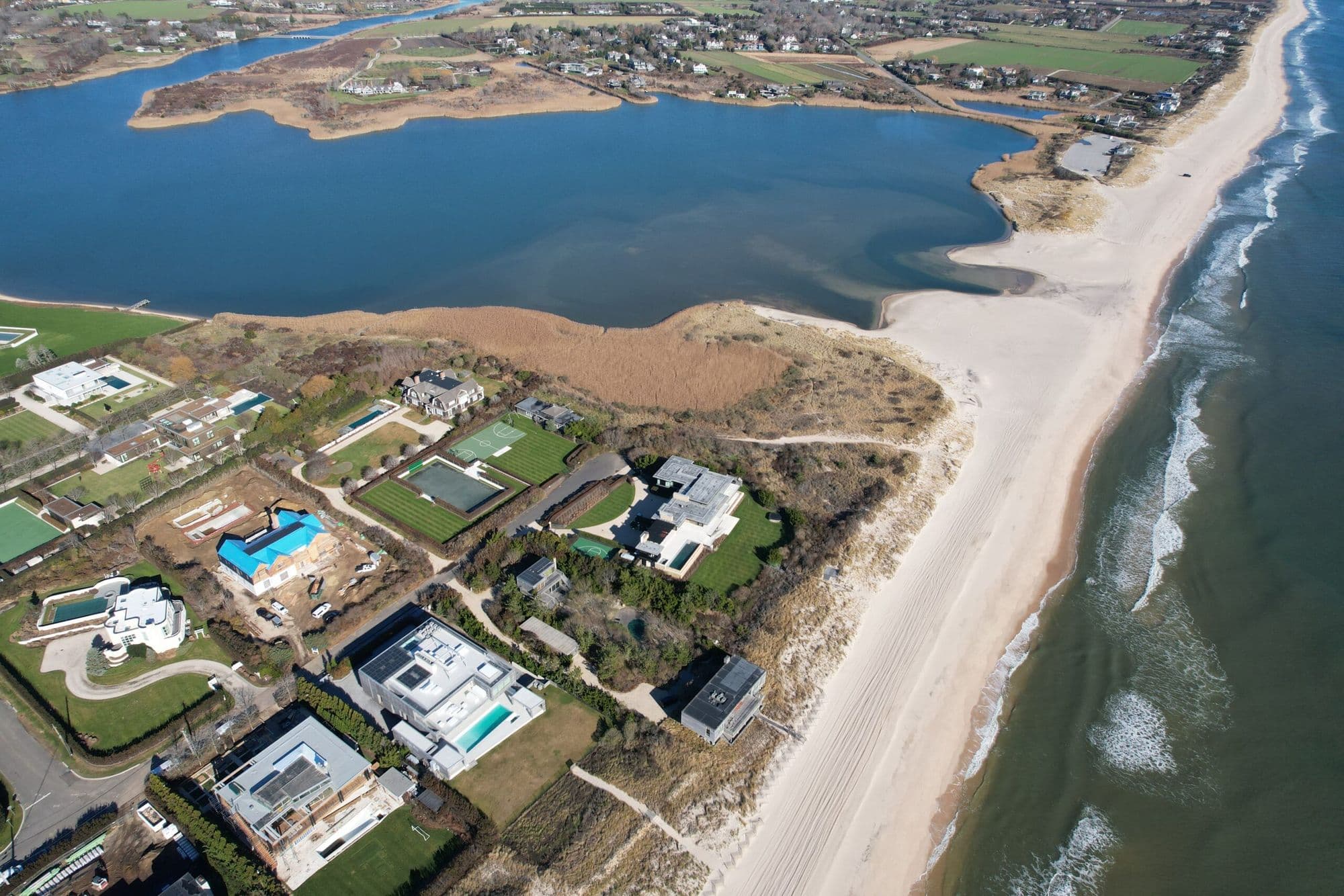
San Francisco can, over long cycles, still invent some high-end product. The Hamptons oceanfront cannot. There are roughly 27 miles of ocean coastline from Southampton to Montauk. That is the inventory. You cannot IPO a new barrier beach. You cannot raise a Series H and manufacture another oceanfront parcel in Sagaponack. Every serious sale removes a scarce asset from circulation, often for a generation.
Limited supply plus a buyer pool that keeps getting richer is not a complicated thesis. It is the entire East End story, only now the buyer pool is about to get a new tranche of capital that makes prior bonus seasons look polite.
What the Hamptons Already Showed Us
We do not need to invent the pattern. Wall Street already ran a smaller version of this experiment at the top of the market.
In 2025, Hamptons sales volume hit about $6.2 billion, up roughly 26% year over year. Financiers made up over half of buyers. Trades above $20 million surged. Bonus season compressed the calendar. Off-market share stayed high because the best inventory never needs a public bidding war to clear.
That was finance wealth recycling into a fixed geography. AI wealth is finance wealth's louder cousin: larger paper fortunes, younger balance sheets, and a cultural preference for trophy lifestyle assets once liquidity hits. San Francisco is proving the demand side in real time at three thousand dollars a foot and climbing. The Hamptons prove the supply side every season: fewer true oceanfront and compound offerings, more capital chasing them, and price discovery that keeps resetting higher whenever a rare listing appears.
If you believe OpenAI and Anthropic list at anything close to the valuations being discussed, you should also believe a non-trivial share of that new net worth shows up in limited-supply trophy markets. Not all of it. Enough of it.
Why This Is Different From "Tech Buyers Are Coming"
Every cycle has a narrative about the next buyer. Sometimes it is crypto. Sometimes it is private equity. Sometimes it is international capital. Those waves matter. This one is different in size and in timing.
Size: we are talking about company-level liquidity events that can exceed years of the entire U.S. IPO market. The purchasing power landing in private hands is out of scale with the thin stock of true trophy homes.
Timing: the wealth is arriving into a Hamptons market that is already inventory-constrained at the top. We are not starting from a soft book of vacant oceanfront. We are starting from a market where the best properties trade quietly, rentals book early, and every acre of true waterfront feels more finite than it did five years ago.
Put those together and you get the same physics San Francisco's ultra-luxury market is living through, applied to a coastline that cannot sprawl.
What I Am Watching
Liquidity dates. Confidential filings are not closings. Roadshows slip. Valuations get negotiated down. But the direction of travel is clear enough that waiting for the exact ticker day is a luxury buyers in scarce markets often regret.
Secondary markets first. Before the IPO bells, secondary share sales and high cash comp already move housing. After the bells, lockups and staged selling stretch the wealth into the market over quarters, not a single weekend. That is a multi-season demand story for trophy inventory, not a one-week headline.
Oceanfront and compound inventory. The first dollars usually chase the irreplaceable: oceanfront, bayfront with depth, gated acreage, village-adjacent privacy. That is exactly the slice of the East End that is shortest.
Cross-coast capital. Some of this money stays in the Bay. Some of it diversifies. The Hamptons compete with Miami, Aspen, and the rest of the trophy circuit. Our edge is not "cheaper." It is specific: Atlantic oceanfront, New York adjacency, and a social calendar that still concentrates decision-makers in one place for a season.
The Bottom Line
AI IPOs are going to create a class of liquid wealth that makes ordinary IPO seasons look small. San Francisco's ultra-luxury market is already pricing that future in, with high-end talk moving from roughly $3,000 a square foot toward $5,000. The Hamptons cannot print more ocean. Demand from newly rich households keeps expanding. True inventory does not.
That is not a tip to panic-buy anything with a shingle. It is a clear-eyed read on the setup: when historically large liquidity events meet a market defined by scarcity at the top, price is the release valve. We have seen the finance version of this. We are watching the AI version start in San Francisco's high end. The East End will feel it wherever true limited supply still sits on the water.

About the author
Barry McGovern is a Licensed Real Estate Salesperson with Hedgerow Exclusive Properties, a boutique ultra-luxury Hamptons brokerage that has facilitated over $2 billion in transactions since 2020. Dublin-born and a Sag Harbor local since 2013, Barry focuses on oceanfront, waterfront, estate-section, and private-market opportunities from Southampton to Montauk, and has been involved with the firm's landmark and record-breaking work.